LinkedIn Content Strategy Canvas
Step by step: Finding the right content for your success as a personal brand

Step by step: Finding the right content for your success as a personal brand
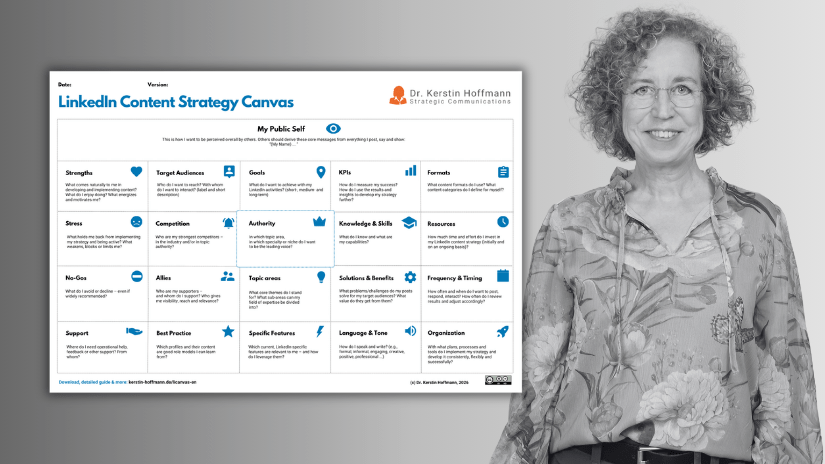
You can now also fill in the LinkedIn Content Strategy Canvas directly online. Enter your answers in the individual fields and download your result as a PDF.
Free, no sign-up required, no personal data needed.
Can you think of any other benefit or value? I would love to hear from you!
(for personal use only)
For more than a decade, I have been designing and supporting brand ambassador/corporate influencer strategies and programmes for companies of all sizes and industries. I work very closely with the people involved, both workshops and in individual coaching sessions. Almost every such programme includes a Social CEO strategy, which requires special attention and intensive development. For more than twenty years I have been guiding top managers, executives and other prominent figures on their personal communication and digital media journey.
As I have accompanied so many personalities in so many different positions — both in groups and one-on-one — I have developed my own methodology. It has proved its worth in many thousands of hours of consulting and workshops. Time and time again, I have found that I can really facilitate success in this area – and also help to avoid many a distraction.
This is achieved by asking the right questions, backed up by a wealth of experience. Of course, this can only be partially translated into a written tool. But such a tool can be very helpful. That’s why I’ve put the basic steps into the Personal Branding Canvas – complete with instructions. It has already been tested in practice.
It has already been tested in the field. But I am curious to hear about your experiences with it!
While self-development certainly can’t replace individual counselling and guidance, I see how motivated and independent my coachees continue to work with my methods, tools and structures outside of counselling sessions. That is why I believe the Personal Branding Canvas will help you and take you a long way on your journey.
I think it would be great if you’d consider sharing the Canvas as well as linking to this page.
Good luck and enjoy the good work
Kerstin Hoffmann
PS: If you like my approach and would like advice on setting up a brand ambassador programme in your company, or would like to know more about my Social CEO consultancy, please contact me.
Both my website and most of my content are in German, but I have been working with English speaking companies (Europe and USA) as well as multinational companies for over twenty years. So rest assured that I would be happy to do the same for you.


Please share the link to this page with others who might benefit from it.
The LinkedIn Content Strategy Canvas is licensed under Creative Commons (CC-BY-ND). This means that you may distribute and embed the graphic unchanged.
Please do not include the detailed instructions in the text on your own pages, but always refer and link to this page.
Commercial distribution, for example in consulting and training, is expressly excluded. Modification and use, for example in other tools, as well as translations into other languages are not permitted.
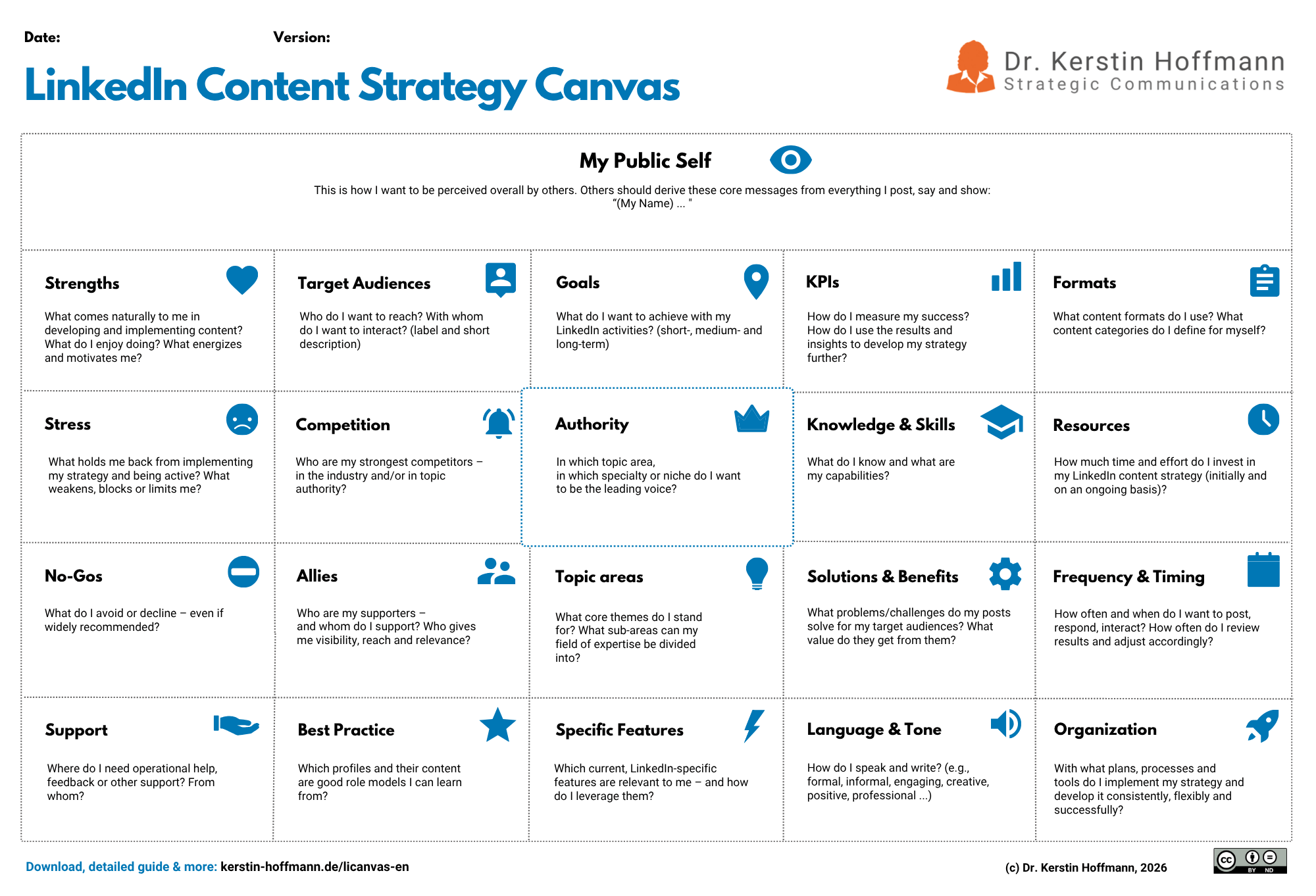
Download the printable PDF here; no sign-up or registration required.
How to work with the LinkedIn Content Strategy Canvas
Start and preliminary note: How working with the canvas becomes truly exciting
Note: I developed the LinkedIn Content Strategy Canvas in and for the consulting of executives and Social CEOs in particular. Some explanations are framed accordingly. However, it works equally well for anyone who wants to work purposefully on their content and its visibility.
Find a quiet place and decide how you want to fill in the canvas. You can print it out, or you can set it up digitally in front of you.
There are also many different ways of approaching it:
Record your results in a form that you can best use, save, and review again later. Each time you work with the canvas, you are creating a snapshot. The result will change over time, and so will the way you use it.
It truly becomes exciting only when you return to it regularly. Think of the individual steps as an iterative process. Even the first time, you will probably move back and forth several times before you are satisfied. The process itself is just as valuable as the result — in the course of it, much will likely become clear to you.
Filling in the individual fields
My Public Self
How do I want to be perceived by others overall? Work out the core messages that others can derive from everything you post, say, and share. These key messages reflect, for example, your professional competence, your style, and your soft skills. Bring these together into a description of your public self. This can consist of several sentences: how would and should someone from your network describe you? It helps to cross-check this point against external perceptions: ask people you trust what they would say about you. And draw on characterizations of you that already exist, for example in the media.
Goals
What do I want to achieve with my LinkedIn activities (in the short, medium, and long term)? Define clear and measurable goals for your LinkedIn activities. Short-term goals might include expanding your professional network, sharing your expertise, or drawing attention to a specific project or initiative. Medium-term goals might encompass increasing engagement rates, generating business opportunities, or improving the visibility of your posts. Long-term goals might include establishing yourself as an authoritative voice — a true authority! — in your field, building strategic partnerships, or advancing your career.
KPIs
How do I measure my success? How do I use the results and insights to further develop my strategy? Define clearly which key performance indicators (KPIs) you will use to measure your success. These can be quantitative metrics such as the number of followers, engagement rates, clicks on your website, or speaking invitations. Equally important, however, are qualitative KPIs: who follows me, who engages, which content gets viewed, what kind of speaking opportunities do I receive?
Use the indicators to review your progress regularly. Analyze the insights to continuously improve your strategy. At this point we only touch briefly on KPIs. Like other fields in this canvas, this field serves to point toward a larger area of work.
Knowledge & Skills
What do I know and what can I do? Your content strategy rests not least on the knowledge with which you create value for your network, as well as on your ability to convey that knowledge. As an executive, for example, you have expertise from your industry and from your company’s area of specialization, across the various functions within the organization. Above all, however, you are likely distinguished by your strategic thinking. You have developed your own approach to decision-making. You stand for leadership culture and company values. You offer others orientation. All of this should be evident in the content you publish, and should shape the way you participate in conversations and respond to questions.
Authority
Work out for yourself: in which topic area, specialized field, or niche do I want to be the leading voice?
Authority in terms of meta-skills refers to the skills, knowledge, and experience of a person that go beyond their specific professional focus — things like leadership style, corporate strategy, decision-making, risk management, or fostering employee engagement. One example might be a CEO who has guided her company through a difficult economic period and shares her experiences and insights in crisis management and financial restructuring. Another example would be a board member who has successfully built an inclusive corporate culture and speaks about how to foster diversity and inclusion within an organization. These individuals build the authority that allows them to be perceived as thought leaders from their own expertise and lived experience.
Topical authority or subject-matter authority refers first and foremost to the recognition and trust that a person enjoys in a particular field. It is the position in which they are among the most respected voices and have thus established themselves as an outstanding source of information. The authority of a Social CEO goes even further: it describes a person who, through the combination of knowledge, skills, and experience, sets the trends in a particular area or even in the public sphere, shapes opinions, and takes a leading role in discussions.
Topic Areas
What core themes do I stand for? Into which different sub-areas can my field of specialization be divided? This lays the foundation for continually finding new topics and developing content from them that is useful to your network. All of them contribute to the authority you described in the previous point on the “Authority” field. Different aspects take center stage in turn. A list of topic areas you want to cover should later become part of your topic development and editorial planning.
The relevant topic areas are identified, described, and prioritized. This refers both to your own strategic goals and to the relevance for various stakeholders, who should also be ranked by priority. Here again, cross-checking with the existing communication and content strategy within the organization and with the CEO’s communication to date is helpful.
Target Audiences
Who do I want to reach? Who do I want to interact with? Draw on audience analyses and personas from corporate communications. But also work through personally, once more, who you truly want to reach. Specify this for your LinkedIn content strategy — meaning in relation to the target audiences you want to reach via this platform. Concrete examples of real, existing people can be used as idealized reference points.
Solutions & Benefits
What problems/challenges do my posts solve for my target audiences? What value do they get from them? In the course of your activities you will discover which content performs best and which formats are most successful. Continuous observation and performance measurement are therefore indispensable. At this point it can help to remind yourself once more that this is not just about your own interests. The better your content is aligned with your target audiences, the more value it generates for them.
Competition
Who are my strongest competitors — in the industry or in topical authority? Positioning yourself within your peer group and your industry is a decisive success factor. This includes monitoring the competition: how is the leadership of your direct competitors positioned on LinkedIn? Which other figures are also staking a claim to thought and opinion leadership in my core field? Draw on data and analyses from corporate communications to identify the relevant people on the chosen platform and analyze their activities: what do they do well? Where do you see yourself better positioned? What can you learn from them? How can you set yourself apart from them? Answers to questions like these help you set reference points for your own strategy and position yourself clearly.
Allies
Allies can often be found even among direct market peers. Beyond that: who are my supporters — and whom do I support? Who lends me visibility, reach, and relevance? You will get better at identifying this over time. At the same time, the question reminds us that social networks are about building and nurturing relationships. Think about which other executives, companies, or organizations share your goals and values, and how you can support each other.
Stress
This is a very personal question, and one worth pausing over for a moment. What is holding me back from implementing my strategy and being active? What weakens, blocks, or limits me? The paradigm shift that comes with having a personal presence on social media is a significant challenge — not only for executives. Perhaps you have concerns about direct accessibility when, up to now, your assistant and the press department have filtered all enquiries. Perhaps you worry about fitting the additional activities into your schedule, or simply do not feel like maintaining a constant online presence. Perhaps you lack knowledge about how to use LinkedIn effectively, and secretly worry about embarrassing yourself. Do you have concerns about exposing yourself in the digital public sphere, or about being put on the spot by others? Are you afraid of being too sensitive to criticism?
It helps to be honest with yourself — at least privately — about such inner resistances, which can affect even highly experienced leaders just as much as anyone else in the organization. These insights influence what your personal strategy looks like. Some concerns can be quickly dispelled with reliable information. Others are signposts for what approach suits a person on the one hand, and how they would prefer not to show up on the other.
Strengths & Preferences
Resistances and stress points are identified. Now make deliberate use of your strengths above all — the qualities and preferences that require no effort from you and no overcoming of reluctance: what comes particularly naturally to me in developing and executing content? What do I enjoy? What energizes and motivates me?
As a leader, you most likely already have a clear sense of your communication strengths. If you are still relatively early in your career, there may be more to clarify here.
Perhaps you are particularly good at writing thought leadership articles or designing presentations. You are probably well practiced at conveying your ideas in interviews or talks. You have almost certainly been through media training and do not fear a camera or microphone — and if you do, as a company spokesperson you know how to handle it. All of this makes it easier to produce content that reaches your desired target audiences. You may not always manage to focus exclusively on what comes easily.
Where it is possible, however, it saves time and effort — for you and for your team — when others support you on your content strategy. This is where you define the interfaces for support from others: if you enjoy designing graphics or taking photos yourself, you can do so. But executives do not need to build every presentation themselves or handle image sourcing. Even if you can manage some things by hand: focus on what truly requires you to do it yourself. Delegate what your team can handle just as well.
No-Gos
What do I avoid or decline – even if widely recommended?? Reasons might include: it conflicts with my values. It does not fit my sense of self. It makes me uncomfortable in other ways. The social web is full of advice on how to build greater visibility, generate large follower counts, or make posts go “viral.” Not all of it is sensible for everyone. Not all of it suits every strategy. Some of it is even questionable. But even in serious consulting you will probably receive tips for your personal communication that you do not want to follow. This can be true even when you yourself objectively consider them useful, but still cannot personally identify with them. This is not only about pure social media questions such as: “How many selfies do I want to post?”
On many levels you will have certain boundaries you do not want to cross, and not only since you started thinking about “social.” Some of your perspectives will probably change, however, once you have gained experience — not in relation to your own values, but perhaps around formats or, for example, the courage to show yourself as a person. Stay open and attentive to this.
Support
Where do I need operational help, feedback, or other support? From whom? In the previous fields of the canvas you have already touched several times on where it may be sensible or even necessary to have support from.
As a Social CEO you hold the reins of your personal communication in your own hands. But it is unlikely that you will implement every aspect of your content strategy yourself. You may need operational support from a marketing or communications team. You might work with external sparring partners in strategy development. Especially in the beginning, a mentor can provide valuable feedback and an outside perspective.
This field serves to record systematically, once more, where and to what extent you have already identified a need for support. It also serves as a reminder to organize this collaborative work on the content strategy going forward.
Best Practice
Which profiles and their content are good role models I can learn from? Not only those who are relatively new to social networks should keep a sharpened eye on other profiles. Positioning yourself within the network also means staying alert to good examples: who in my industry or in similar positions has a strong presence on LinkedIn — and how do I recognize it? What do they do particularly well in my view? What can I learn from them? What appeals to me immediately? But also: what do I not find as good, or what would not fit my own profile?
It is of course not about copying others, but about being inspired and identifying proven practices. This observing and collecting never stops. You will probably not fill in this field in the first round at all, but use it as a prompt to look closely on an ongoing basis and build up a collection in the right place.
Language & Tone
How do I speak and write (e.g., formal, informal, engaging, creative, positive, professional …)? Your own unique way of expressing yourself — your language and tone in all its variations — form a defining element of your public self. Tone, however, varies depending on context, target audience, and occasion.
Platform-Specific Features
Which current, LinkedIn-specific features are relevant to me – and how do I leverage them? The features of social networks change frequently, both in details and sometimes on a larger scale. Some disappear. New ones are added. Established technical possibilities lose their significance. You therefore need processes for staying up to date and using the features accordingly.
Formats
What content formats do I use? What content categories do I define for myself? At this point we move directly into the practical implementation of your content strategy. When starting out you will probably only be able to fill in this field if you already have LinkedIn experience and the goal is simply to record your current status. Otherwise it is worth flagging this for later. Identify any need for clarification or further development. Use continuous competitive monitoring and your best practice collection to further develop your own formats.
Resources
How much time and effort do I invest in my content strategy (initially and on an ongoing basis)? Executives do not suddenly have more time available when they open up new communication channels. Both in the initial development phase and in ongoing operations, engagement requires time and attention. You need this to create content and participate in discussions. You observe and analyze, and on the basis of the insights you develop your approach further. Your team supports you in this, and coordination takes time. Time resources often need to be redistributed for this purpose. Many people find that they stop attending certain event formats as their virtual network grows, because they recognize, for example, that these are no longer keeping pace with the times. The quick, uncomplicated exchange via direct message may save you many a phone call.
Define right from the start how much time you want to invest. Experience shows that it is sensible in the beginning to set upper limits rather than lower ones. These determine the scope of possible activities. Stick to your self-imposed time budgets for at least a certain period to find out how they can be maintained during different phases of professional workload. Adjust as needed, and remember to prioritize: keep doing what works well. Do not waste time on formats and activities that have proven less effective. For this you need performance measurement — equally important for the next point.
Frequency & Timing
How often and when do I want to post, respond, and interact? How often do I review success and adjust if needed? Consistency and regularity: two key success factors for any social strategy. Regular activity spares you a constant up and down in the algorithm and therefore in how you are perceived in your network. The time resources we looked at in the previous point also influence frequency. Set targets for how often you post and interact, and plan when you want to do this.
Time management and editorial planning is a process. It develops continuously. When you have support, however, you need a shared plan that everyone adheres to. You can only measure success when certain parameters are fixed. These include the frequency of posts, reactions, and comments, as well as the times at which you are active.
Organization
With what plans, processes, and tools do I implement my strategy and develop it consistently, flexibly, and successfully? Beyond the platform’s own features, you need plans for yourself and for team implementation. You need to organize processes. Tools for editorial planning, performance measurement, and monitoring are part of this. For precisely this reason, isolated solutions must be avoided — neither for a single platform nor for a single person.
Use the tools and structures already in use in your overall communications. If you add new ones, create interfaces that meet the communication standard within the organization. It is not an executive’s job to select the tools and plans and operate them hands-on. But they should be able to interpret the results and take them into account in strategy development.
Design a structure together with your team that makes the work straightforward. Remember that it should be documented in a way that everyone understands. It should be easy to bring additional people into these workflows.
Well done!
You have completed the first round with the LinkedIn Content Strategy Canvas. I hope you enjoyed it and that you are keen to continue working with it.
What comes next?
By completing the LinkedIn Content Strategy Canvas you have laid a solid foundation.
With a content strategy that is as clear as it is flexible, you have the best possible starting point for translating your personal communication strategy into actual content.
With an explicit definition of your goals, target audiences, and authority, and with clarity about your own strengths and boundaries, your communication — as professional as it is personal — rests on solid ground. With the right planning and execution, LinkedIn — or another network of your choosing — becomes your central platform within your personal communication mix for positioning yourself.
Careful implementation and constant review are an important part of the ongoing work. This alone keeps the strategy dynamic. It should change and grow as you change. You can therefore pick up the canvas regularly and work through it again. You will probably be surprised how much new ground you cover each time!
Set a date right now to revisit your results, review them, and develop them further. If you worked through it with someone else: even better! Make a firm appointment with your sparring partner.
* * *
Please don’t forget:
Recommend the canvas to others.
Would you like to give me feedback?

You want to launch a brand ambassador/corporate influencer programme? You are a Social CEO or you accompany your CEO in digital media and are looking for an experienced sparring partner? Do you need support in your communication strategy? Do you want to plan and implement an effective content strategy?
Contact me for goal-oriented advice and support.
Book me for the keynote at your event or for a specialised lecture.
Fluent in German and English.
Fill in online, download your results as PDF
Here’s how it works:
Important: All entries remain exclusively in your browser. Do not reload the page while working and do not close the tab — otherwise all entries will be lost.