TRAFFIC LIGHT OF CONTENT
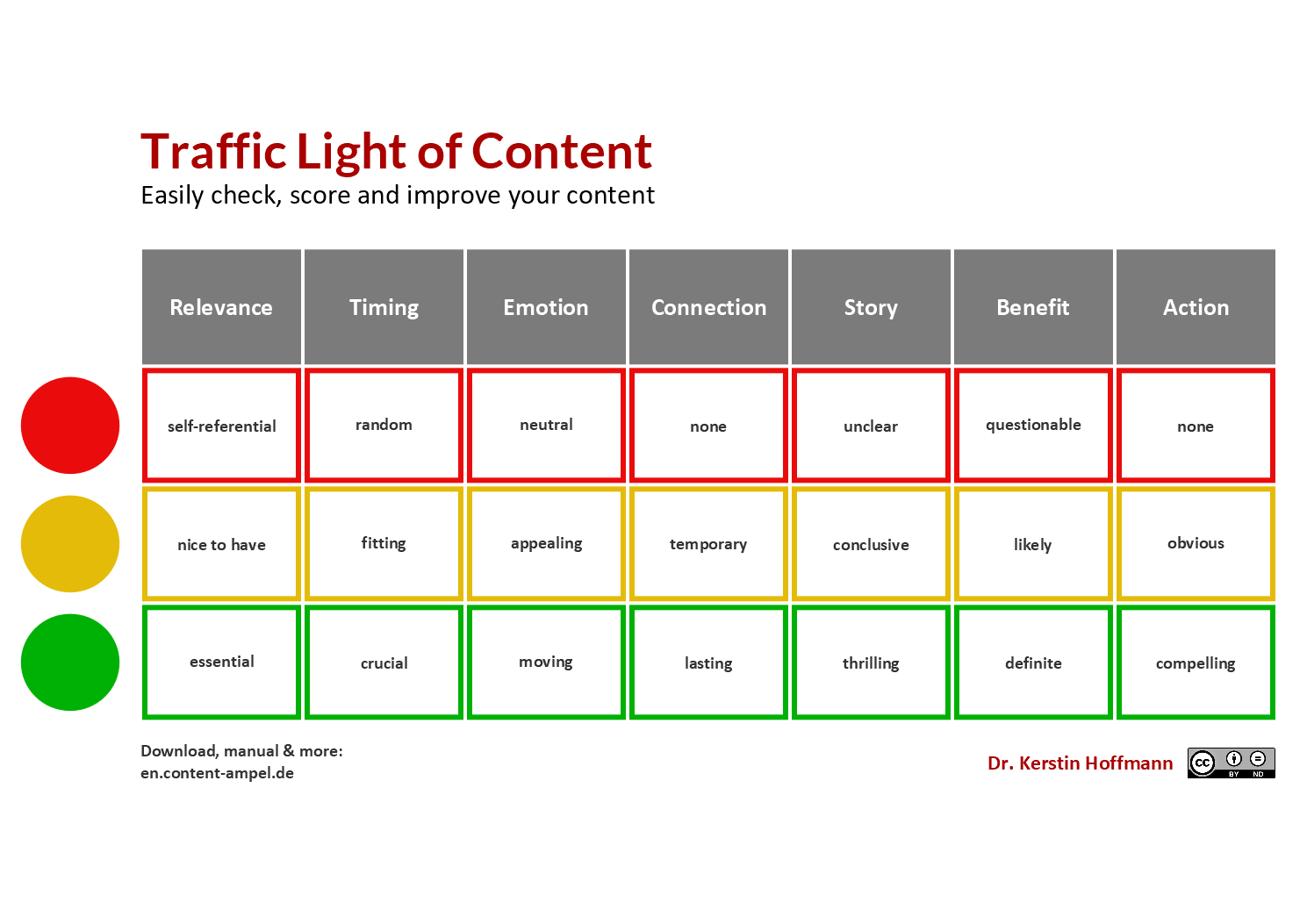
Easily check, score and improve your content

Easily check, score and improve your content
Check your content online and view detailed evaluations for each individual criterion as well as the overall assessment. Download the evaluation for each piece of content as a PDF.

Help others improve their content by sharing the link to this webpage with them.
How can content marketing, marketing and PR succeed in creating content that exactly meets the needs of your target groups – permanently and in each individual case? How effectively do you contribute to the strategic and communication objectives of your company? How can you reliably check existing content?
In everyday work-life, it is often difficult to adhere to the quality standards that have been set once and to implement them. This is why I developed the content traffic light. Here I present you this valuable tool free of charge – with instructions and detailed questions about all seven criteria.
The content traffic light helps you and your team to quickly assess and improve your content in the main aspects that are crucial for your success – and thus also learn how to produce better content in the future.
A large number of people in companies and organizations, but also individual authors, have tested this easy-to-use score card and use it daily. May it help you, too.
Kerstin Hoffmann
Download starts immediately; no registration required (PNG, ca. 1 MB).
The Content Traffic Light is under published Creative Commons license. This means that you are allowed to pass them on and embed them unchanged.
A commercial disclosure, for example in consultation and training, is expressly excluded. Modification and exploitation, for example in other tools, as well as translations into other languages are not permitted.
– Promotion –
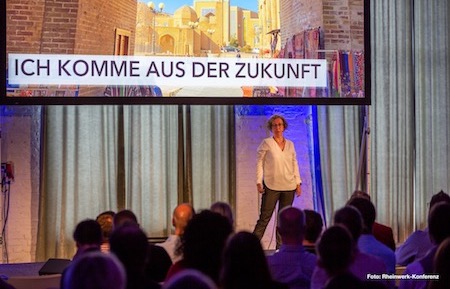
„Lively, captivating, humorous and extremely substanciated“, that’s what professionals say about Kerstin Hoffmann. Your audience will love her talks and will learn a lot.
All talks are available in English and will be adapted to the special needs and requirements of your audience.

Your products and services are outstanding, because you have invested a lot. Your customers are highly satisfied or even give enthusiastic feedback. That’s why you love what you are doing. But what about your community? What do you know about them? Do you use the same networks and platforms they do? And: Do you have a strategy, or are you still trying? Let’s figure this out together!
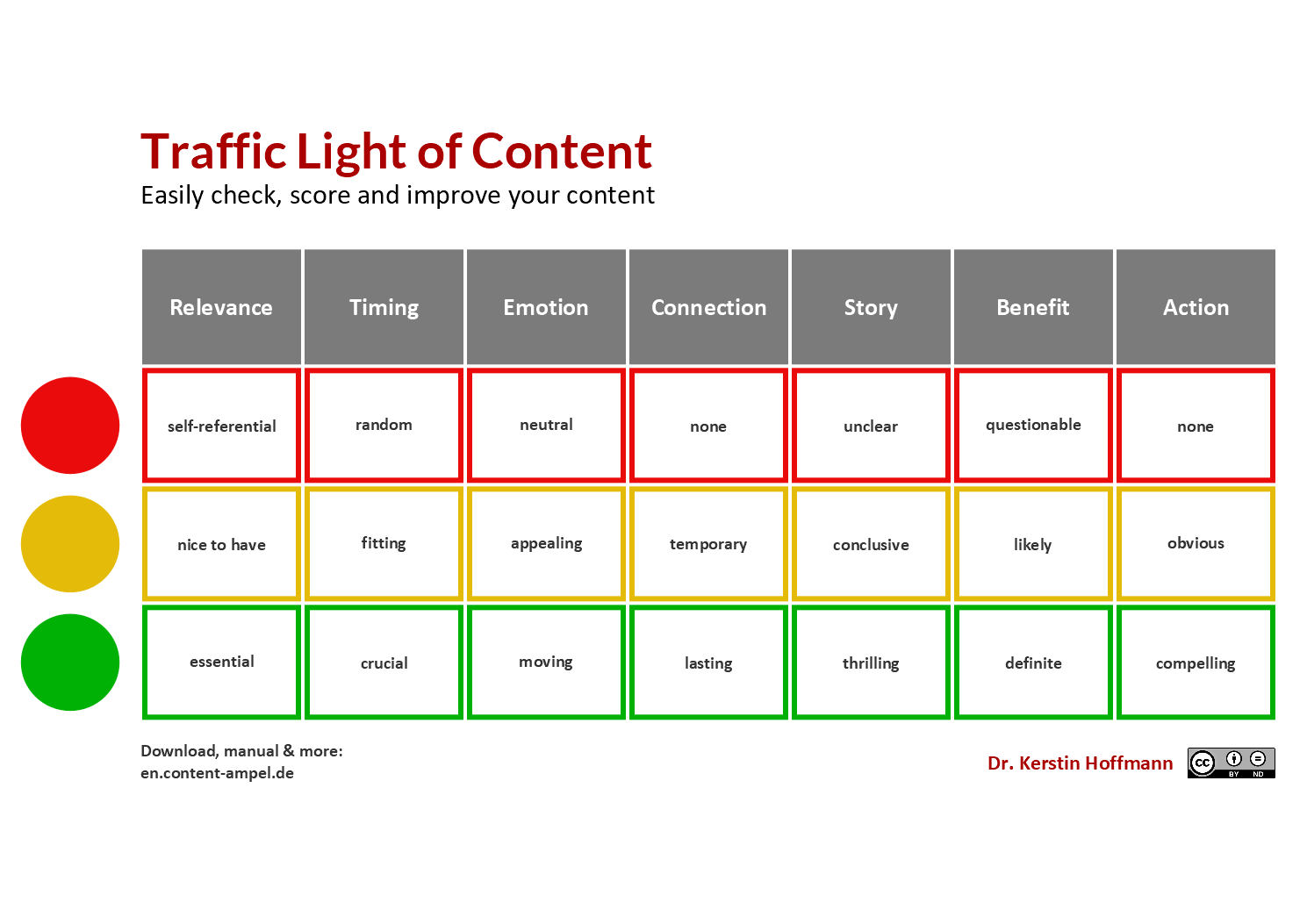
Based on the seven criteria and their corresponding options, any type of content, post, or even early-stage topic idea can be evaluated – from a single photo to a long-form text, from a social media post to an e-book. The scorecard is not an objective instrument; rather, it is grounded in the specific content (marketing) strategy and the user’s expertise. However, it makes it remarkably easy to apply that expertise quickly and in a targeted way – without constantly having to refer back to the strategy manual or other guidelines.
The traffic-light system can also assist in internal discussions. For example, someone in the company – perhaps an executive – insists that the communications team should develop a particular topic for the corporate blog and distribute it across all social media channels. A quick check using the traffic light reveals that the topic doesn’t even achieve a decent (that is: yellow) average score in any area. This provides strong, objective arguments for either postponing the topic or taking another look at it: How can we adapt, refine, or expand the idea so that the resulting content scores better?
The simplest and fastest way to use the traffic light is to place it next to your content and select one field for each of the seven criteria. A more detailed analysis with nuanced sub-criteria is available through the interactive tool. You can use it directly in your browser and download the results as a PDF. Alternatively, you can use it offline by selecting one of the three statements for each criterion.
Help others improve their content by sharing the link to this webpage with them.
The Content Traffic Light is a tactical tool. It complements the content strategy, but does not replace the strategic development. On the contrary: the better your strategy, the more effective your work with the content traffic lights can be.
In particular, you should ask the following questions before you start scoring your content:
This tool is currently in a testing phase. Have you discovered a bug? Something is not working? Would you like to give feedback? Please write to me!
Here you can enter a code, inventory number, or label for the content piece you are checking. It is stored locally in your browser and included in the PDF you can download afterwards:
For each of the 7 criteria, you will find 3 statements. Please click a number from 1 to 5 for each statement:
1 = does not apply at all
5 = fully applies
Additional tip: Not everything has to be green. Nice to have content makes sense within a comprehensive content marketing strategy. Not everything can be of the highest relevance. Predominantly self-referential content, however, should be used only very sparingly and with careful consideration.
Additional tip: Not everything has to be green. Nice to have content makes sense within a comprehensive content marketing strategy. Not everything can be of the highest relevance. Predominantly self-referential content, however, should be used only very sparingly and with careful consideration.
Additional tip: Not everything has to be green. Nice to have content makes sense within a comprehensive content marketing strategy. Not everything can be of the highest relevance. Predominantly self-referential content, however, should be used only very sparingly and with careful consideration.
Additional tip: In most content marketing strategies, a balanced mix of evergreen content and content that is critical at a specific time is recommended. For that, it is crucial to identify the needs of your target audiences and stay in conversation with them.
Additional tip: In most content marketing strategies, a balanced mix of evergreen content and content that is critical at a specific time is recommended. For that, it is crucial to identify the needs of your target audiences and stay in conversation with them.
Additional tip: In most content marketing strategies, a balanced mix of evergreen content and content that is critical at a specific time is recommended. For that, it is crucial to identify the needs of your target audiences and stay in conversation with them.
Additional tip: Content can trigger very different emotions, from goodwill to resistance. Even purely factual content can be more or less engaging depending on wording. That is why it is important to work deliberately on tone in your content strategy.
Additional tip: Content can trigger very different emotions, from goodwill to resistance. Even purely factual content can be more or less engaging depending on wording. That is why it is important to work deliberately on tone in your content strategy.
Additional tip: Content can trigger very different emotions, from goodwill to resistance. Even purely factual content can be more or less engaging depending on wording. That is why it is important to work deliberately on tone in your content strategy.
Additional tip: Content marketing strategies should not be designed only for short-term results, but should create long-term relationships and brand loyalty. This works particularly well through visible people as brand ambassadors, through Corporate Influencers.
Additional tip: Content marketing strategies should not be designed only for short-term results, but should create long-term relationships and brand loyalty. This works particularly well through visible people as brand ambassadors, through Corporate Influencers.
Additional tip: Content marketing strategies should not be designed only for short-term results, but should create long-term connections and brand loyalty. This works particularly well through visible people as brand ambassadors, through Corporate Influencers.
Additional tip: Every good piece of content follows a thread and has an internal logic that keeps the recipient engaged. This applies not only to telling real or fictional stories, but also to any short factual piece.
Additional tip: Every good piece of content follows a thread and has an internal logic that keeps the recipient engaged. This applies not only to telling real or fictional stories, but also to any short factual piece.
Additional tip: Every good piece of content follows a thread and has an internal logic that keeps the recipient engaged. This applies not only to telling real or fictional stories, but also to any short factual piece.
Additional tip: The value for recipients should be recognizable at first glance, but it must also hold up under closer inspection. Content is useful only if something changes through it. That does not always have to be an insight gain. Entertainment value can also be a form of value.
Additional tip: The value for recipients should be recognizable at first glance, but it must also hold up under closer inspection. Content is useful only if something changes through it. That does not always have to be an insight gain. Entertainment value can also be a form of value.
Additional tip: The value for recipients should be recognizable at first glance, but it must also hold up under closer inspection. Content is useful only if something changes through it. That does not always have to be an insight gain. Entertainment value can also be a form of value.
Additional tip: Some content motivates sharing, some leads directly into a purchase process, and some strengthens perception, meaning image. Not every piece of content should or can include an explicit call to action. What matters is that you clearly define the desired action or change in attitude for yourself.
Additional tip: Some content motivates sharing, some leads directly into a purchase process, and some strengthens perception, meaning image. Not every piece of content should or can include an explicit call to action. What matters is that you clearly define the desired action or change in attitude for yourself.
Additional tip: Some content motivates sharing, some leads directly into a purchase process, and some strengthens perception, meaning image. Not every piece of content should or can include an explicit call to action. What matters is that you clearly define the desired action or change in attitude for yourself.
Thanks for taking part. It was worth trying, but this piece of content clearly has room for improvement. The target audiences do not reliably see why they should engage with it, and several key points do not work together. Relevance, value, or tone remain unclear in important places, so the content has little impact. A pity for the space and the used bits and bytes.
The good news: the individual evaluations show where you can improve your content in a targeted way.
Potential and further development: A thorough revision is worthwhile, because even small adjustments can significantly improve your content. Start where the lowest individual values are, and work your way forward step by step. Use the statements for each criterion and check how you can achieve a better rating there. It may be worth revisiting the strategy at a more fundamental level. Information about target audiences and their behavior is likely missing. The Traffic Light of Content gives you many ways to work on details while also improving your overall content marketing strategy.
Additional tip: You do not have to turn everything green immediately. Invest deliberately in your premium content. If those pieces stand out positively, others can perform less at times.
The approach is solid, and that is visible right away. The content has clear strengths, but it does not yet reach its full potential. Some aspects already speak well to the target audiences and support your own goals. Others can still be refined in detail.
Potential and further development: For many content pieces, a score like this is completely sufficient. If you want to develop an acceptable piece into premium content, it is worth strengthening the promising elements and working on the weak points in a targeted way. Often, only a few adjustments are needed for the content to resonate more strongly and create more response. Use the statements for each criterion and check how you can achieve a better rating there. The Traffic Light of Content gives you many ways to work on details while also improving your overall content marketing strategy.
Additional tip: This evaluation is initially based only on your own assessment. That is why monitoring and success measurement are so important. Test variants as a next step and observe where response increases. This helps you develop a feel for how to reach your target audiences best with the right content.
Well done. If your self-assessment based on the questions is accurate, you have created a very strong piece of content that can really move your content marketing forward. Your content addresses the target audiences clearly, delivers a clear gain, and remains understandable throughout. Relevance, tone, and value work together coherently and motivate the other person to stay engaged and continue.
Potential and further development: This content piece is a strong example of how professional communication works. You have clearly done a lot right in the basics and in the strategic groundwork. You have the information you need so your content reaches the desired conversation partners and also supports your own goals. Use this piece as a template to develop more content in a similar direction and expand it deliberately.
Additional tip: Check which elements work particularly well here. Transfer them to other formats or topics. Step by step, this creates a reliable style, and you will need to check your content less often. What matters is the response from the other person. Monitoring and success measurement must show how well your content actually resonates with your target audiences.
This tool does not process personal data. Inputs are made locally in the users’ browser and not transmitted
Kerstin Hoffmann is one of Germany’s top experts, bloggers and book authors in communications strategy. Kerstin holds a PhD in Philosophy and has also taught at Heinrich Heine University (Düsseldorf).
Her blog „PR-Doktor“ is one of the most read and leading blogs about communications and marketing.
She has published several books that have become recognized as authoritative works in her discipline.

Help others improve their content by sharing the link to this webpage with them.